Average Lot Size for a House
The median lot for a new single-family home sold in the US in 2025 was 8,307 square feet, about 0.19 acre, according to the Census Bureau. That's roughly 83 by 100 feet. For detached houses only, the National Association of Home Builders puts the median at 8,543 square feet.
Lot size in 2025
Every official median for 2025 lands between 8,300 and 8,900 square feet, about one fifth of an acre. The Census figure above counts all single-family homes sold, townhouses included, while NAHB's counts detached houses only. Lots for homes built on the owner's land run much bigger:
Census median, including homes built on the owner's land.
The NAHB median for new detached homes sold in 2019.
Median for custom homes started in 2025, built on the owner's land.
These are medians: half of new lots are smaller, half bigger. Census lot size figures exclude condo sales, per its survey definitions. The 2026 figures come out in mid-2027.
What a typical lot looks like
A median lot is about 83 by 100 feet. The figure shows a median-size new house on one floor; on two floors, its footprint would cover only about 13 percent of the lot.
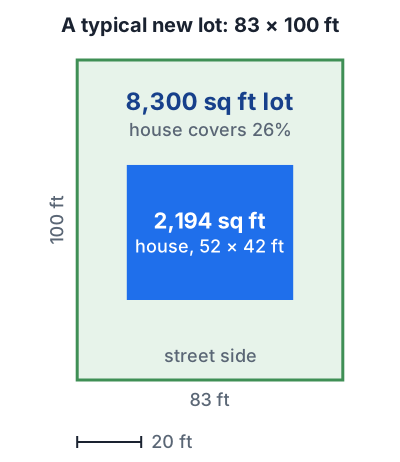
Lots are sold by area, but plats and listings give width and depth. To turn either into acres, use the square feet to acres converter, or see how the size of the house itself compares in average square footage of a house.
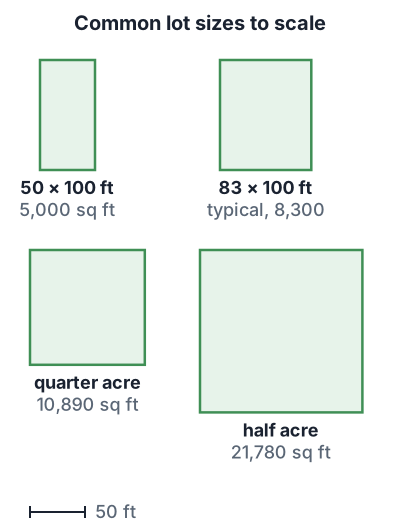
Common lot dimensions in square feet and acres
| Lot (feet) | Square feet | Acres |
|---|---|---|
| 50 × 100 | 5,000 | 0.11 |
| 60 × 120 | 7,200 | 0.17 |
| 75 × 100 | 7,500 | 0.17 |
| 83 × 100 | 8,300 | 0.19 |
| 100 × 100 | 10,000 | 0.23 |
| about 104 × 104 (quarter acre) | 10,890 | 0.25 |
| 100 × 150 | 15,000 | 0.34 |
| about 148 × 148 (half acre) | 21,780 | 0.50 |
| about 209 × 209 (one acre) | 43,560 | 1.00 |
How lot sizes have changed
New lots have shrunk since the late 1990s and have held near a record low since 2019. Since the 2019 low, the NAHB median for new detached homes sold has been 8,456 square feet in 2021, 8,524 in 2022, 8,400 in 2023, 8,506 in 2024 and 8,543 in 2025.
The clearer change is in small lots. In 1999, 46 percent of new detached homes sold sat on lots under 9,000 square feet; by 2025 it was 64 percent.
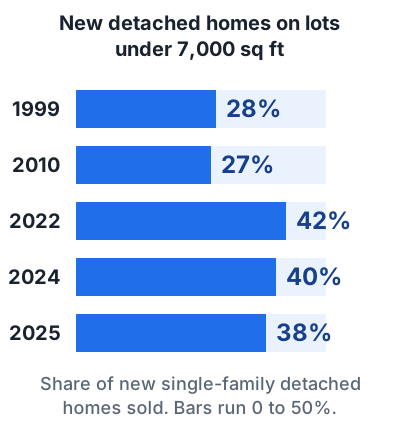
Sources for the chart: NAHB's analyses of Census data for 1999, 2010 and 2024, 2022 and 2025.
Lot size by region
Lot size depends heavily on where you build. Among new detached homes built for sale and started in 2025, NAHB found the biggest lots in New England and the smallest on the Pacific coast:
Median about double the national figure; half of lots are over 0.4 acre.
Kentucky, Tennessee, Alabama and Mississippi.
Below the national median.
Half of lots; about half the size of lots next door in East South Central.
Half of lots, the smallest of any division.
Zoning in much of the country pushes the other way. Over half of single-family-zoned land in the National Zoning Atlas requires lots of 40,000 square feet or more, and only 3 percent allows lots under 10,000 square feet.
Older homes have bigger lots
Existing homes sit on far more land than new ones. In the 2005 American Housing Survey, the median lot was 0.36 acre for homes with a lot, almost twice today's new-home median, per the Census Bureau's Statistical Abstract.
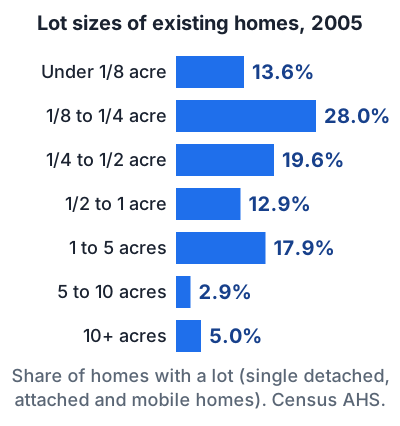
That survey includes rural homes and mobile homes, which is why one in four homes sat on an acre or more. It's two decades old, so treat it as a direction, not today's number.
Lot size vs yard size
Your yard is the lot minus everything built on it: the house footprint, driveway, patio and walks. On the typical lot in the figure above, a one-story house leaves about 6,100 square feet before the driveway.
Three yard and lot numbers to stop repeating. "23,301 sq ft average yard" comes from averaging state averages, so rural states with huge lots pull it up. "13,896 sq ft" is an average (mean) new-home lot from 2020, which big lots inflate, quoted as if it were typical. And "8,560 sq ft average backyard" is close to the median size of a whole new lot, not a yard.
To measure the lawn you'd actually seed or sod, use the lawn calculator.
How to find your lot size
Your lot size is on your deed, the recorded plat or survey, or your county's property records.
- Check the county. The assessor's site or GIS map lists lot area, often in acres, by address or parcel number.
- Read the plat or survey for the exact width, depth and angles of each boundary.
- Do the math for a rectangle: width × depth. An odd-shaped lot goes into the irregular shape calculator, and the converter below turns square feet into acres.
Frequently asked questions
What is the average lot size for a house in the US?
The median new home sold in 2025 sat on 8,307 square feet, about 0.19 acre. Existing homes sit on more land; a 2005 national survey put their median at 0.36 acre.
How big is a typical suburban lot?
About 8,300 square feet for new construction, roughly 83 by 100 feet. Lots in older neighborhoods tend to be bigger: the 2005 American Housing Survey put the median for existing homes at 0.36 acre.
How many acres is a 50 by 100 lot?
0.11 acre. A 50 by 100 foot lot is 5,000 square feet, and an acre is 43,560 square feet.
Is a quarter acre a big lot?
It's bigger than most new lots. A quarter acre is 10,890 square feet, about 30 percent more than the 2025 median for new homes sold.
Why do new homes have such small yards?
Because new lots are small. In 2025, 38 percent of new detached homes sold were on lots under 7,000 square feet, against 28 percent in 1999, while the median new home sold was still 2,194 square feet.
What is the average backyard size?
There's no official figure for backyard size. Subtract the house, driveway and patio from your lot size to get yours.